
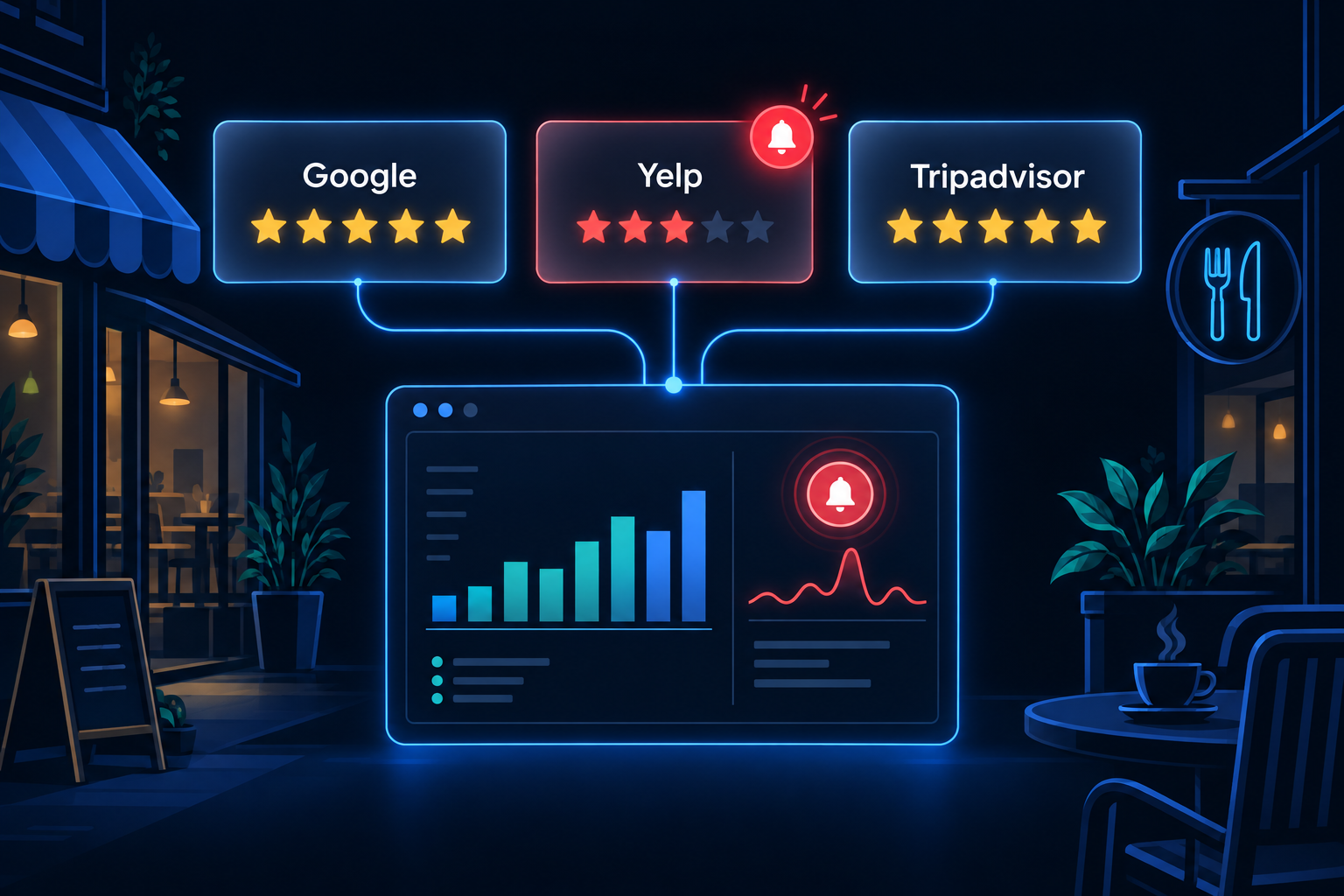
This is a restaurant review management AI case study: how Repwatch — technical design and deployment by EchoAI, business development by Kepler — gave a multi-location restaurant group unified review data, minute-level negative-review alerts and human-approved AI replies across all three platforms, live in production in 5 days (Sep 20–24, 2026).
Challenge
A multi-location restaurant chain was drowning in reviews across three platforms — Google, Yelp, Tripadvisor — with no unified view:
- No alerting. When a negative review landed, nobody knew until a manager happened to scroll. Discovery was measured in days.
- One third answered. Only 545 of 1,637 negative reviews (33%) had ever received a reply from the business.
- Broken data. The existing pipeline had never extracted owner replies from Yelp or Tripadvisor — 5,968 Yelp reviews all showed
has_owner_reply = 0. The dashboard leadership trusted was wrong. - Manual replies. Every response was written from scratch, with no consistent voice.
The problem wasn’t lacking review data. It was that data existed, but nobody saw it — and nobody answered.
Solution
Repwatch — delivered by EchoAI (technical design & deployment) with Kepler (business development) — unified all three platforms into one pipeline, deployed to production in 5 days (Sep 20–24, 2026).
1. Unified review pipeline (Google + Yelp + Tripadvisor)
- Single ingestion pipeline across all three platforms, incremental sync, rate-limit aware pagination.
- Found and fixed two data-integrity bugs: owner-reply extraction had never worked on Yelp (DOM selector) or Tripadvisor. Backfilled history → 1,935 previously-missing owner replies recovered (0% → 32.4% accurate).
- Crawling moved from 1× to 2× daily, halving review discovery latency.
2. Negative-review alerts
- Fires only when all three conditions hold: rating ≤ 3 + no owner reply + confirmed synced — so staff never get notified about data they can’t yet see.
- Delivery chain: group message @ store manager → private-message fallback → logged skip (no repeated pinging).
- Same-store candidates are batched into one message per cycle — minimal noise, minimal API load.
- A baseline mechanism absorbed 1,411 historical open negatives on day one instead of flooding channels; only genuinely new reviews alert thereafter.
- Notifications run on the existing 45-minute sync cycle — once a review is ingested, staff hear about it within the hour.
3. AI reply drafts — never auto-published
- Every qualifying negative review gets a suggested reply in the same pipeline as AI tagging.
- SOP voice is distilled from the manager’s own published replies — the AI mimics their tone, not a call-center script.
- Drafts are never sent automatically. A human reviews and publishes.
- Quality guardrail proven in production: of 131 backfilled drafts, 117 generated cleanly and 14 were correctly refused by the AI (review had no text — it declined to invent details).
4. Management dashboards
- Lark dashboards per platform: totals, average rating, monthly trend, complaint taxonomy.
- Store enable/disable and platform IDs are configured in a Lark table — new stores require zero code changes.
Results
| Metric | Before | After |
|---|---|---|
| Negative-review discovery | Manual polling, day-level | 2× daily crawling |
| Store manager notified after discovery | No mechanism (depended on someone scrolling) | Group message @ owner within sync cycle (≤45 min) |
| Owner-reply data | Yelp/Tripadvisor stuck at 0 (wrong) | 1,935 rows backfilled, accuracy 0% → 32.4% |
| Negative-review reply coverage | 33% (545 / 1,637) | 100% of new negative reviews reach staff + AI draft attached |
| Reply copy production | Written from scratch every time | AI drafts (in the store manager’s own voice) + human review before publishing |
| Platforms & configuration | 3 platforms scattered, store config hardcoded | Unified pipeline + Lark-table driven, new stores zero code |
| Delivery timeline | — | Live in production in 5 days |
Production proof: after launch, one real 3-star negative review completed the full chain end to end — system detection, AI reply suggestion, group notification — with zero manual effort to discover it.
In the client’s words
“Before Repwatch, I found out about a bad review by accident — scrolling three apps between shifts, days later. Now it hits our group chat the same day, with a draft reply written in my own words already attached. I read it, adjust a sentence, send. Five days from kick-off to live — I honestly didn’t expect it to move that fast.”
— Operations lead, a multi-location restaurant group
Delivery roles
| Role | Responsibility |
|---|---|
| EchoAI | Technical solution design, development and production deployment |
| Kepler | Business development (BD) |
| Repwatch | External project name (productized delivery brand) |
Engineering details
- Reports are fully redacted; credentials never land in documents.
- Lark transient API timeouts degrade gracefully instead of interrupting — notification rounds are never lost (occurred 2× in production, both self-healed).
- Automatic log rotation (5MB compression, 8-week retention) — unattended operation.